Passion or Market: Which One Should Choose Your Next Video?
There is a line every creator hears early on: make what you love and the audience will find you.
It is a lovely sentence. It is also the reason a lot of good work sits at forty views.
Here is the pattern I have watched play out repeatedly. Someone spends a month on a video they care about. The research is real, the edit is careful, the audio is clean. It goes out, and almost nobody watches. Two weeks later a far simpler video on a neighbouring subject does numbers the first one never came close to.
The difference is not craft. It is fit. One video answered something people were already looking for; the other answered a question only its maker was asking.
The platform does not reward complexity
New creators tend to read poor results as a production problem. Better transitions, more effects, a nicer camera. Sometimes that is the issue, but far more often it is not.
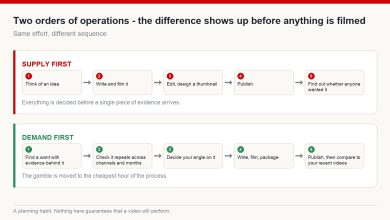
What gets rewarded is relevance. A plain video that lands squarely on an existing need can beat a video with ten times the effort in it, which is precisely why channels with no face, no studio and no equipment budget can pull large audiences. Nobody is choosing the video for its production values. They are choosing it because it looked like the thing they wanted.
So the useful question is not “how do I make this better?” It is “was anyone looking for this?”
What passion is for, and what it should not decide
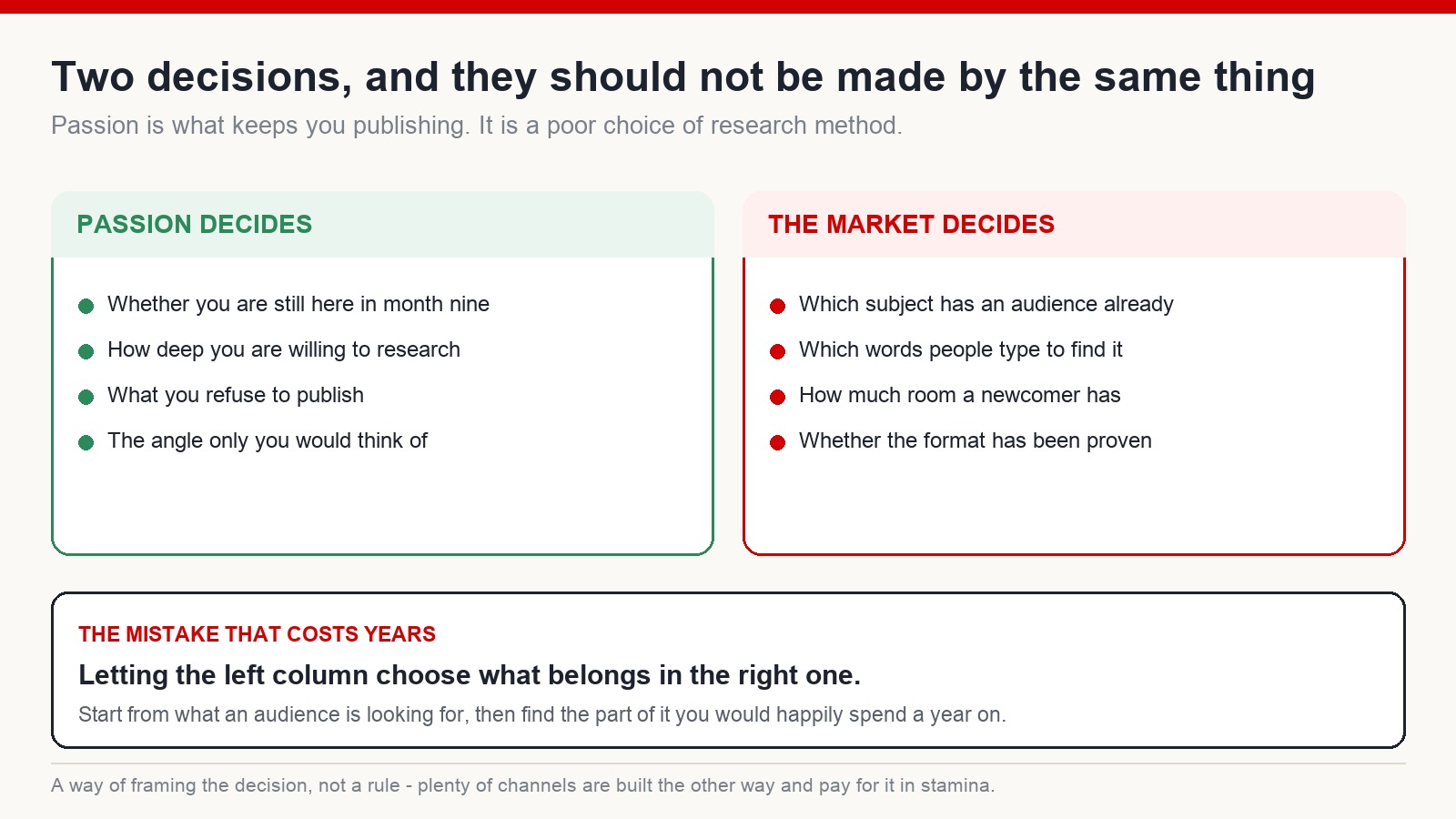
I am not arguing against making things you care about. Interest is what gets you to video sixty when the numbers have not moved yet, and no amount of market data supplies that.
But the two decisions are different. Passion is a fuel question. Which subject, and which words people use to find it, is a research question. When you let the first answer the second, you end up with a niche that only you can see.
The way out is not to abandon what you like. It is to start from what people are searching for and then find the part of it you would genuinely enjoy spending a year inside. That intersection almost always exists – it is just narrower than the version in your head.
Let the market answer instead of guessing
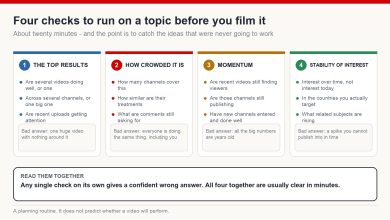
The data you need is sitting in public. A short version of the check:
- Find several channels that are clearly working in your subject and still growing.
- Sort their videos by view count and look only at the top handful. That is what audiences chose, as opposed to what the creator thought they were making.
- Group those winners. If a channel’s best videos cluster into three or four repeating shapes, the shape is the niche – not the label on the channel banner.
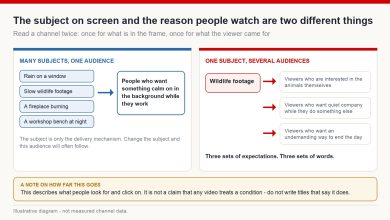
The precision matters. “Animal content” is not a finding. “Wildlife rescue told as a rescue story” is. Broad category descriptions feel like insight and give you nothing to make on Monday.
And when most of the winning videos in a subject sit in one group, that group is where the attention already is. You can go somewhere else because you prefer it, but you are then paying to create demand rather than serving it, and that is an expensive way to start.
Two kinds of keyword, doing two different jobs
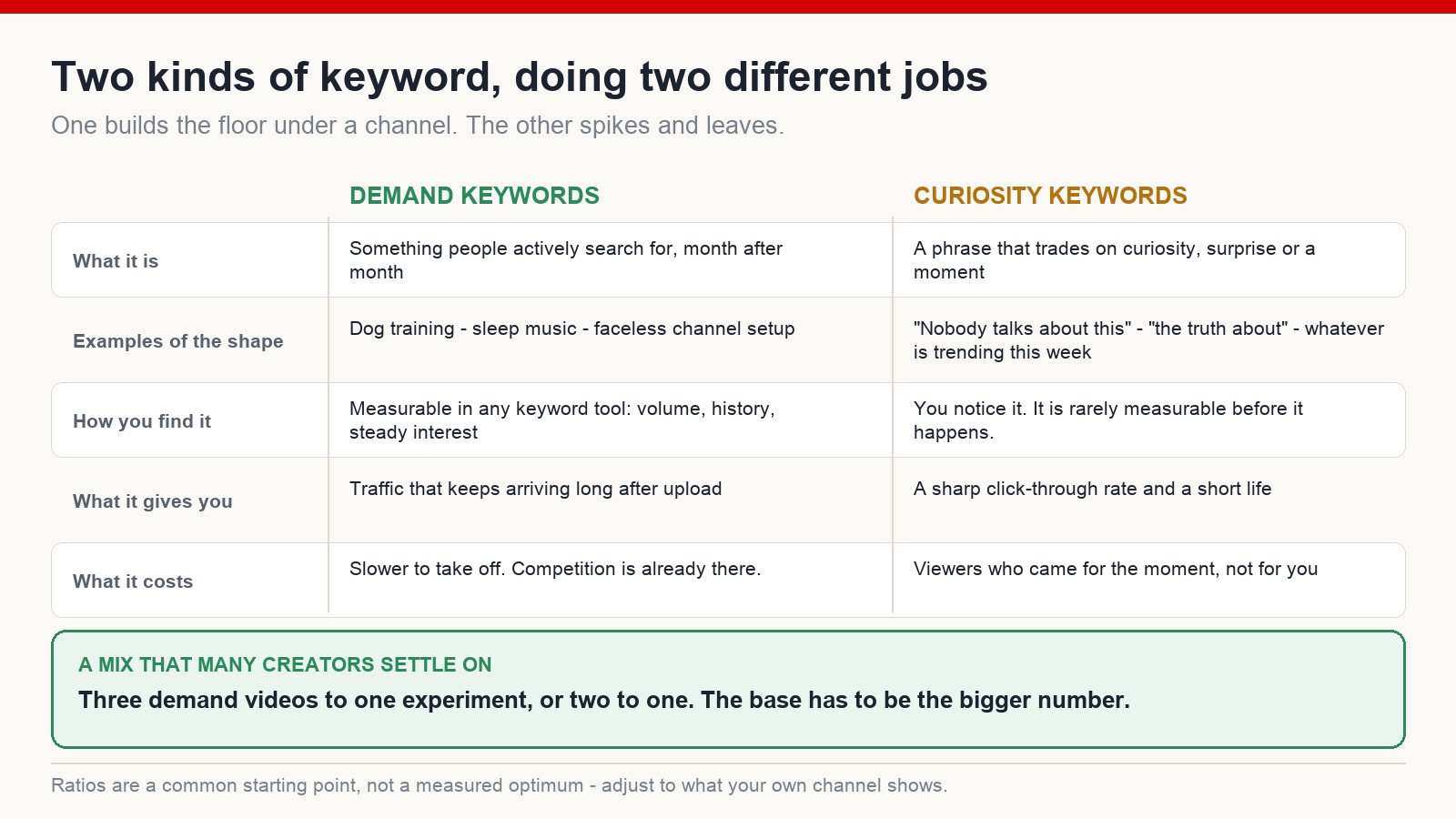
Most of the confusion about topic selection disappears once you separate the two kinds of phrase you can build a video around.
Demand keywords are things people actively search for, month after month – dog training, sleep music, faceless channel setup. You can measure them in any keyword tool: there is volume, there is history, there is a pattern that existed before you arrived. Videos built on them keep collecting traffic long after upload.
Curiosity keywords trade on surprise, secrecy or a moment. They are the “nobody talks about this” and “the truth about” phrases, plus whatever is trending this week. They can produce a sharp click-through rate and a spike of views, and there is nothing wrong with that – but the people who arrive for a spike frequently do not stay for the channel.
Neither type is superior. The mistake is building entirely from one of them. All demand and no experiments makes a channel that grows slowly and never breaks out. All curiosity makes a channel with a good month and no floor under it.
A mix worth starting from
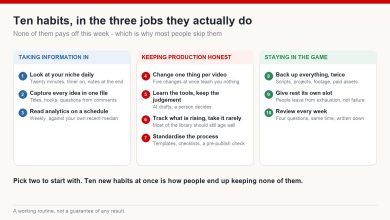
Many creators settle somewhere around three demand videos to one experiment, or two to one. What matters is not the exact number but which side is bigger: the base has to outweigh the gambles. Run it for a couple of months, look at what your own retention and returning-viewer numbers say, and adjust from there rather than from anyone else’s ratio.
The signal that tells you there is room
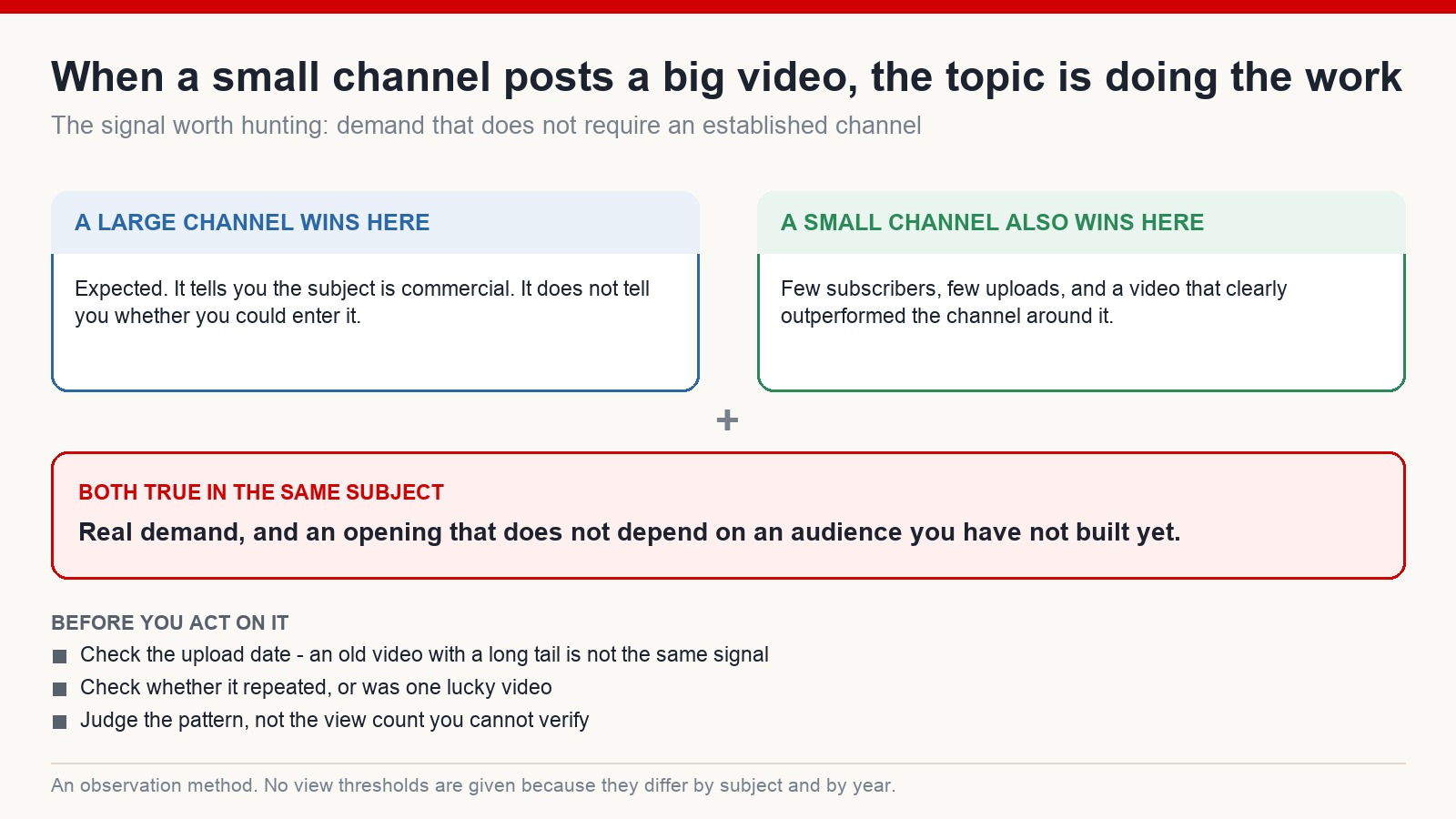
A big channel doing well in a subject tells you the subject is commercial. It does not tell you whether you could get in.
The more interesting signal is the opposite one: a channel with few subscribers, few uploads and a video that clearly outperformed everything around it. When that happens, the channel is not what is doing the work. The topic is. Nobody arrived for the brand, because there is no brand yet.
When you can see both in the same subject – established channels winning, and newcomers occasionally winning too – you have found demand that does not require an audience you have not built yet. That is the opening.
Three cautions before you act on it. Check when the video went up, because an older video with a long tail is a different signal from a recent breakout. Check whether the channel repeated it or was simply lucky once. And judge the pattern rather than the specific numbers, since you cannot verify anyone else’s figures from the outside and they are not a forecast for yours.
What to do before your next video
- List the three strongest channels in the subject you are considering.
- Look at their most-watched videos and write down the repeating shapes, in specific language.
- Find several small or new channels in the same subject and check whether any of them have a video that outran the channel.
- Take the two or three demand phrases that survive all of that, and confirm there is real search interest behind them.
- Then ask the passion question – which of these could you keep making for a year – and let it choose between the survivors, not before.
You will find more in an hour of that than in a week of thinking alone at a desk. Let the market pick the subject, and let interest carry you through the part where nothing is happening yet.
Is it a mistake to build a channel purely around what I love?
It is not a mistake, but it carries more risk. If the audience for that subject is small or is not looking on YouTube, the ceiling is low no matter how good the work is. Go in knowing that, rather than discovering it in month eight.
What exactly is a demand keyword?
A phrase that reflects an actual, repeating search behaviour – measurable in keyword tools, with history behind it – rather than a phrase a creator assumes people type.
Is the small-channel signal useful for beginners?
It is the most useful single signal available to a beginner, because it points at subjects where a newcomer has been able to break through recently. Verify it across several channels before you commit.
How should I split demand videos and experiments?
Three to one, or two to one, is a reasonable starting point. Treat it as a starting position rather than a rule, and let your own results move it.
What matters most when choosing a niche?
Not how many subscribers your competitors have. Evidence that both established and new channels are getting watched in the same subject – that combination says demand is real and the door is not closed.
If you want to see this research process applied end to end for an English-speaking audience, that is what I teach at mmoyoutube.com. Results vary between channels and platform behaviour changes over time – treat any pattern here as a way of looking, not a promise.